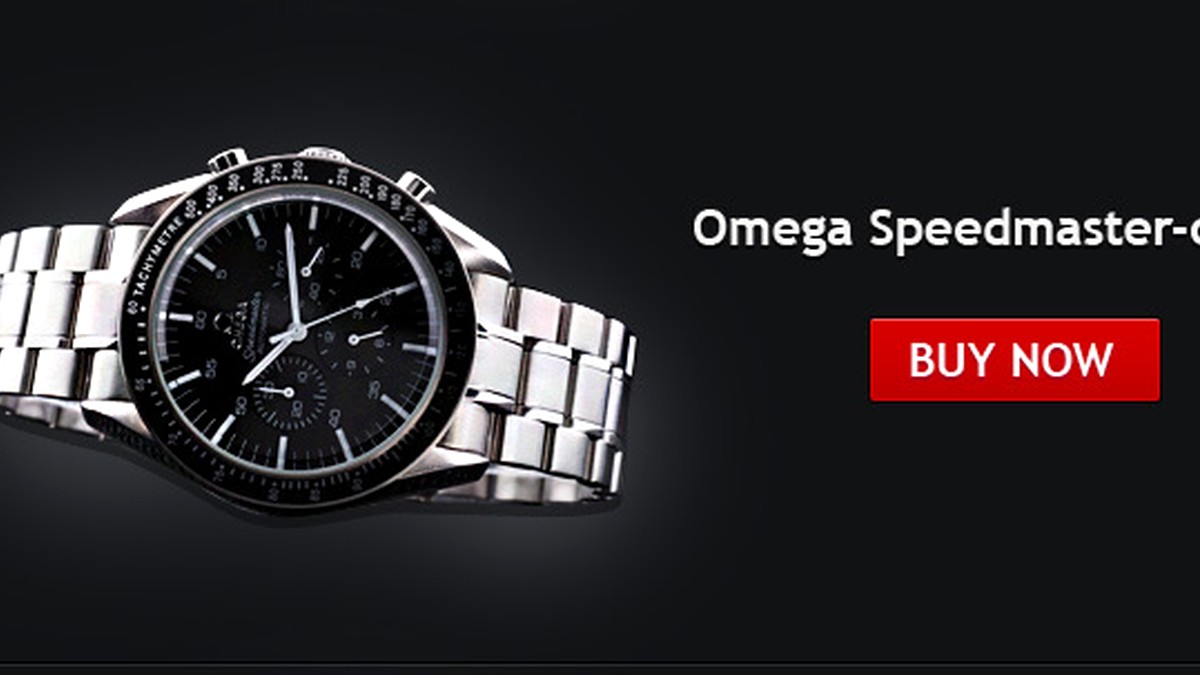
The Moonwatch story is useful because it defines the design
OMEGA’s Speedmaster became flight-qualified by NASA in 1965 and was worn during the Apollo program, including the first lunar landing. The historical point matters because today’s Moonwatch deliberately preserves many fourth-generation design cues: an asymmetrical 42 mm case, stepped dial details and the famous tachymeter “dot over 90” treatment.
Subdial spacing is one of the fastest quality checks
Movement architecture controls where the chronograph registers sit. A substitute automatic or quartz movement can shift them outward, change the running-seconds location or alter case thickness. Compare the exact subdial positions and confirm which register performs which function. A photograph can reveal spacing; a video confirms operation.
Tachymeter bezel and case profile
The Speedmaster’s black tachymeter bezel is a major visual cue. Check printing weight, the “dot over 90” position on Moonwatch-style references, bezel alignment and the transition into the twisted-lug case. Side photos should show the chronograph pushers, crown and case thickness without excessive bulk.
Manual-wind versus automatic replicas
The current Moonwatch Professional uses the manually wound Co-Axial Master Chronometer calibre 3861. Many replica or homage-style alternatives use automatic or quartz movements. That does not automatically make them unusable, but it changes winding behavior, thickness, rotor sound and sometimes the dial layout. A listing should describe the actual movement rather than borrowing genuine specifications.
Bracelet and crystal choices
Current Moonwatch variants use vintage-inspired bracelet proportions, while different genuine references may use sapphire or hesalite-style crystals. A replica buyer should confirm which reference is being copied. Bracelet taper, clasp fit, end-link shape and crystal profile can make a larger visual difference than minor logo spacing.
Speedmaster QC order
- Straight-on dial photo for subdial spacing and marker alignment.
- Bezel close-up for tachymeter printing and alignment.
- Side profile for case thickness, pushers and crown.
- Chronograph video demonstrating start, stop and reset.
- Caseback and movement photo if calibre claims are important.
- Bracelet/clasp and measured wrist-sizing information.
The Speedmaster dial is busy, but it is not random
A correct Moonwatch-style layout has a deliberate relationship between the central pinion, three registers, minute track and tachymeter bezel. Check whether the subdials sit too close to the edge, whether their hands are centered and whether the printing density changes around them. A substitute movement often reveals itself through altered subdial spacing long before the caseback is opened.
Manual winding changes the user experience
The modern Moonwatch Professional remains a manual-wind chronograph. A replica using an automatic movement adds a rotor and may become thicker; a quartz version changes pusher feel and subdial behavior. None of those choices automatically make the watch bad, but the listing should describe the actual architecture. Buyers who value a Moonwatch-like winding ritual may prefer a manual-wind layout, while others may prioritize convenience.
Case geometry: twisted lugs and asymmetry
The Speedmaster’s case is not a generic round chronograph shell. Its asymmetrical profile protects the crown and pushers, and its twisted lugs combine brushed and polished surfaces. Check the watch from above and from both sides. Soft, overly rounded lug transitions or a crown/pusher set that protrudes too far can make the watch look wrong even at normal wrist distance.
Bracelet and clasp checks
Modern Moonwatch bracelets use a vintage-inspired taper and compact links. Check whether the replica bracelet drapes smoothly, whether end links sit flush, and whether the clasp closes without excessive play. A stiff bracelet can make a 42 mm watch wear much larger than expected.
Lume and dial printing
Ask for a low-light lume photo if nighttime legibility matters. Lume color and brightness should be reasonably consistent across hands and markers. Under normal light, inspect the OMEGA-style logo, minute track and subdial numerals for smudging or uneven depth. Macro photos are useful here because black dials can hide defects in ordinary product shots.
Speedmaster-specific red flags
- Automatic movement advertised as “same as Moonwatch” without explaining the architectural difference.
- Chronograph registers with unrelated 24-hour functions.
- Incorrect tachymeter scale alignment.
- Case thickness hidden by angled-only photography.
- Genuine NASA/METAS claims copied into the replica description.
Hesalite-style versus sapphire-style presentation
Moonwatch references have appeared with different crystal configurations. The crystal changes reflections, edge distortion and the way the dial appears at an angle. When a replica listing says “Moonwatch,” confirm which genuine configuration it is trying to reproduce rather than treating every 42 mm Speedmaster as the same reference.
Chronograph reset is worth repeating
One clean reset is not enough to prove stable operation. Ask for two or three start/stop/reset cycles. The central timing hand should repeatedly return to zero and the subdial counters should not drift. A chronograph is one of the most mechanically demanding features on the site, so repetitive testing is justified.
Keep the Moonwatch generation internally consistent
The Speedmaster has evolved without abandoning its core design, which makes generation mixing easy to spot. A Moonwatch-style replica should have a coherent relationship between dial, bezel, crystal profile, caseback, bracelet and movement type. For example, a watch presented as a modern calibre-3861 Moonwatch should not automatically borrow details from much older references simply because those details are popular with collectors. Decide which generation the watch is intended to reproduce before grading it.
Caseback photography is particularly useful. It can confirm whether the watch is trying to imitate a solid-back, display-back or commemorative configuration, and it can expose a case that is thicker than expected because an automatic movement has been substituted for a manual-wind architecture. The bracelet should also suit the intended generation in link shape, taper and clasp. These larger consistency checks usually matter more on the wrist than tiny differences in printed text.
Frequently asked questions
Was the Speedmaster used on the Moon?
Yes. OMEGA documents NASA qualification in 1965 and Speedmaster use during the Apollo lunar missions.
Does a Speedmaster replica need a manual-wind movement to look correct?
Not necessarily, but a different architecture can change thickness, subdial spacing and user experience.
What current movement is used in the Moonwatch Professional?
OMEGA’s current Moonwatch line uses Co-Axial Master Chronometer calibre 3861.