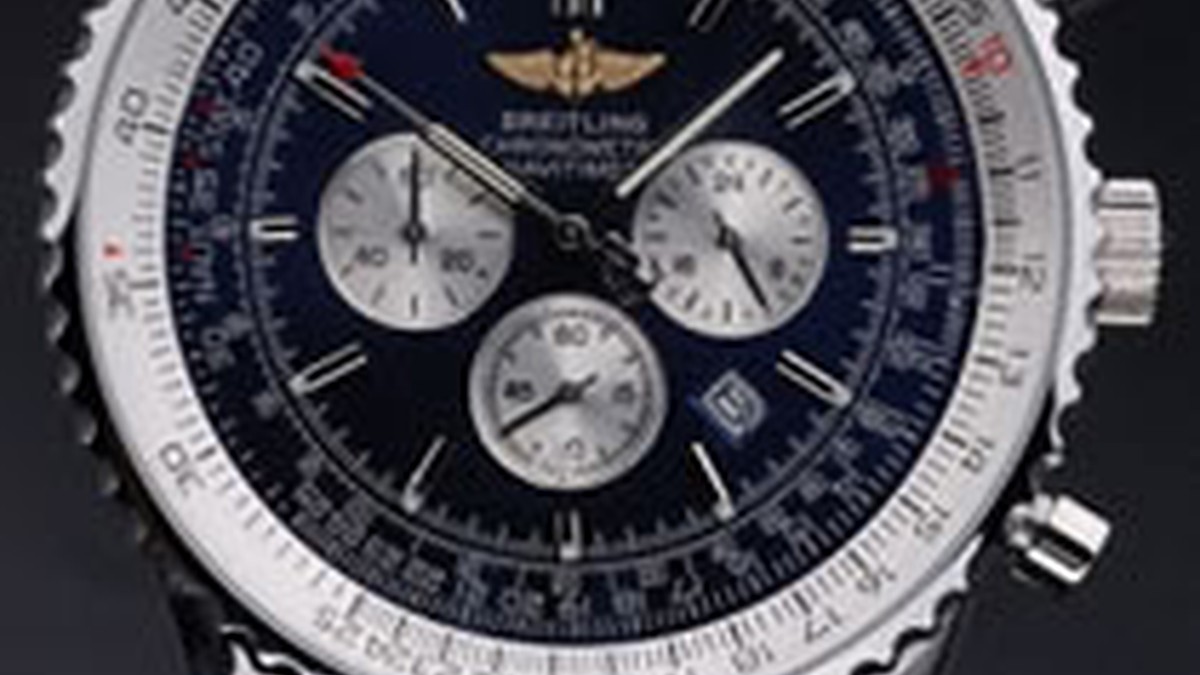
The Navitimer is defined by its slide rule
Breitling traces the Navitimer to 1952, when Willy Breitling developed a wrist chronograph with a circular slide rule for aviation calculations. That functional scale is also the first place a replica can look wrong. The printed scales are dense, so tiny alignment errors between the inner and outer rings are easy to see.
Breitling currently lists the Navitimer B01 Chronograph 43 with manufacture calibre 01, 28,800 vph, approximately 70 hours of power reserve, a 43 mm case and 30 m water resistance. Those figures establish a genuine reference; they should not be repeated as replica specifications unless independently verified.
Check the slide-rule scales at four points
Use a straight-on high-resolution image. Inspect alignment at 12, 3, 6 and 9 o’clock. The rings should be concentric, printing should remain crisp near the edge, and the movable scale should not look visibly off-center. A misaligned bezel can make the entire dial look wrong even when the chronograph registers are acceptable.
Chronograph registers must match the movement
The genuine B01 architecture provides chronograph seconds plus 30-minute and 12-hour timing. Budget quartz copies sometimes substitute different functions or a 24-hour indicator. The useful standard is to check what each register actually does instead of judging only the dial appearance.
Case thickness, crown and pushers
At 43 mm, the Navitimer is substantial but not infinitely thick. Alternative movements can change the vertical position of the stem and pushers. Request a side photo, measured thickness and a short chronograph operation video. Pusher travel should feel deliberate and the reset should return the chronograph hand cleanly to zero.
Dial color and finishing
Breitling has offered the modern Navitimer in multiple dial colors, so “correct color” depends on the exact reference. What remains consistent is the need for legible printing, balanced registers, aligned applied markers and clean hands. Dense dials reward macro photography; they also punish fuzzy catalogue shots.
Water resistance: do not copy the genuine rating
The current B01 Chronograph 43 is rated by Breitling to 30 m, but a replica has its own seals, crystal, crown and assembly quality. If water exposure is expected, ask for a pressure test of the specific watch.
The slide rule should remain usable, not merely decorative
The Navitimer’s circular slide rule is made from interacting scales. On a well-built replica, the scale ring should rotate smoothly, remain concentric and line up predictably. If the ring binds, has excessive play or cannot align cleanly at reference points, it is both a functional and visual defect.
Dense printing requires high-resolution QC
Because the Navitimer carries more printed information than most luxury chronographs, low-resolution photos can hide a great deal. Ask for a full-size straight-on image. Look at numerals near the outer edge, the relationship between the slide-rule rings, subdial text, date aperture and the AOPA-style wing position where applicable. Misprints that seem small can become obvious on the wrist because the dial is designed around precision scales.
Use Breitling calibre 01 to map the expected chronograph functions
The current genuine B01 Chronograph 43 uses a self-winding column-wheel chronograph architecture with 1/4-second timing, 30-minute and 12-hour counters. A replica can use a different movement and still be attractive, but its registers should be described honestly. A 24-hour display should not be presented as a 12-hour chronograph counter.
Crystal and anti-reflective appearance
Breitling specifies a cambered sapphire crystal with anti-reflective treatment on both sides for the genuine B01 model. A replica crystal can look much more reflective. That may reduce legibility on an already dense dial. Ask for photos taken in daylight from several angles rather than judging only studio images.
Bracelet or leather strap fit
Navitimer references are available on bracelet and leather. On bracelet versions, check end-link fit and taper; on leather, inspect lug spacing, spring-bar fit and buckle finishing. The watch has a broad visual dial, so a poorly proportioned strap can make the entire watch feel top-heavy.
Navitimer-specific QC scorecard
- Slide-rule rings concentric and correctly aligned.
- Subdial functions verified on video.
- Case thickness and pusher height measured.
- Date aperture centered.
- Crystal reflections acceptable.
- Bracelet/strap fit clean at the lugs.
Date window and calendar behavior
On many Navitimer references the date is a small aperture inside an already complex dial. That makes depth and centering important. Ask for a straight-on photo at a double-digit date and a short crown-setting video. A date wheel that sits too far below the dial can be noticeable because the surrounding printing is so fine.
When a lower-cost Navitimer can still make sense
A buyer who values the Navitimer look more than chronograph architecture may prefer a simpler movement if the seller describes it accurately. The key is expectation: a lower-cost watch should be judged as a lower-cost interpretation, not marketed with genuine B01 specifications. Clear disclosure is more useful than an inflated “super clone” label.
What a useful Navitimer function video should show
A short video can answer several questions that still photographs cannot. Start with the chronograph fully reset and the watch running normally. Ask the seller to start the chronograph, let the central timing hand run long enough to show smooth and stable motion, stop it, restart it, and then reset it. The reset should return the central hand and counters cleanly to their zero positions. If one register is actually a 24-hour indicator rather than a chronograph counter, the video will usually make that obvious.
Then ask for the slide-rule ring to be rotated slowly through part of its travel. The ring should move without binding and remain concentric with the fixed scale. Finally, a side view while the pushers are operated can reveal excessive case thickness, awkward pusher travel or a crown that sits too high or too low because of the movement inside. These checks are more informative than a factory nickname because they show how the individual watch actually works.
Frequently asked questions
When was the Navitimer introduced?
Breitling traces the model to 1952, with the AOPA adopting the design shortly afterward.
What is the current Navitimer B01 Chronograph 43 movement?
Breitling specifies manufacture calibre 01, a self-winding chronograph running at 28,800 vph.
What is the most visible Navitimer replica flaw?
Misalignment in the circular slide-rule scales and incorrect chronograph register spacing are common visual giveaways.